
Yes, an EV charger can often be installed some distance from the switchboard. The distance itself is not usually the only deciding factor. The electrician needs to assess the cable route, cable size, voltage drop, charger capacity, switchboard condition and the home’s available electrical capacity.
For homeowners planning EV charger installation Perth, this means the charger does not necessarily have to be installed directly beside the switchboard.
There is no single distance that applies to every home EV charger installation.
A longer cable run may be possible, but the installation must be designed to suit the property and charger. Factors such as cable length, current capacity, voltage drop, installation method and protection requirements need to be considered.
The Western Australian Government also recommends asking an electrician how far a charger can be installed from the electrical panel when choosing the charging location.
This is why EV charger installation Perth should be assessed on a property-by-property basis rather than using a fixed maximum distance.
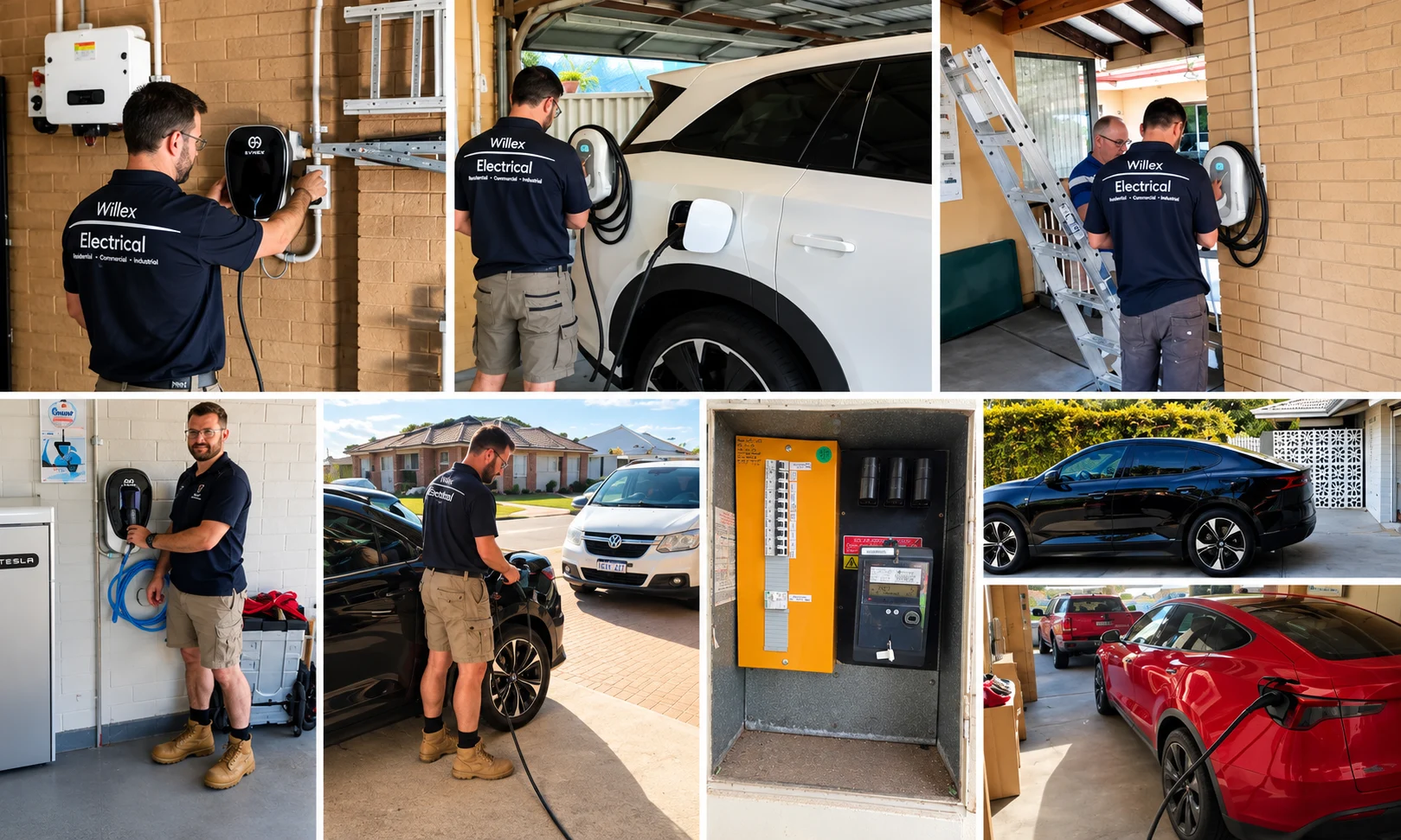
If the charger is located a long way from the switchboard, the electrician may need to install a longer dedicated cable run.
Depending on the property, the cable may need to travel:
The cable must be appropriately selected for the electrical load and installation conditions. A longer run can also make voltage drop an important consideration.
This does not automatically mean the charger will charge slowly. Proper cable selection and installation design are important to maintaining suitable electrical performance.
Cable length can be one factor considered when designing an EV charging circuit, but it does not mean that a long cable run will automatically result in slow charging.
The electrician considers the charger’s rated current, cable size, installation conditions and voltage drop when designing the circuit.
For example, a 7kW home charger places a different electrical demand on a property than a lower-powered charging solution. The available supply and existing household loads also need to be considered.
For EV charger installation Perth, the aim is to design the circuit to safely support the charger and comply with applicable electrical requirements.
A detached garage does not necessarily prevent you from installing an EV charger.
The electrical installation may require a suitable cable route between the main switchboard and the garage. This could involve underground cabling, conduit and additional electrical infrastructure depending on the site.
The condition and capacity of the existing electrical installation also need to be checked before work begins.
If the garage is some distance from the house, a site assessment is particularly useful because the most suitable cable route may not be obvious from inside the property.
Distance is only one part of the assessment.
Adding an EV charger can increase the home’s maximum electrical demand. Western Power states that an EV charging installation must not exceed the capacity of the existing supply and connection arrangement. Where additional load is too high, options can include an upgraded connection or smart EV charging with load-control functionality.
An electrician should therefore check:
This assessment is an important part of safe EV charger installation Perth.
Yes. If your home has solar panels or several high-load appliances, smart charging and load management may help manage the home’s electrical demand.
For example, a smart EV charger can be configured to respond to household electricity use or available solar generation, depending on the equipment and installation.
Western Power specifically identifies smart EV charging with grid import limiting as one possible option when additional EV charging load needs to be managed within the site’s available capacity.
A qualified electrician should assess the proposed charger location and the complete electrical path back to the switchboard.
In Western Australia, electrical installations must comply with the WA Electrical Requirements (WAER) and applicable AS/NZS 3000 Wiring Rules.
For EV charger installation Perth, the electrician should also consider the requirements of the network operator and the charger’s specifications.
After electrical work is completed, the required testing, certification and notification processes must also be followed. WA Government guidance states that an Electrical Safety Certificate is required for electrical installation work and confirms that the work has been checked, tested and complies with the relevant requirements.
The best charger location is not always the closest point to the switchboard.
You may prefer the charger near your usual parking position, inside a garage, on an external wall or in another practical location. A qualified electrician can assess whether the proposed position is suitable and determine the appropriate cable route and electrical requirements.
If you are planning EV charger installation Perth, Willex Electrical can assess your switchboard, charger location, cable route and available electrical capacity before installation.
Not necessarily. Cable size, voltage drop, charger capacity and installation conditions all need to be considered.
Yes, depending on the property’s electrical setup and the feasibility of running a suitable cable to the garage.
Not always. An electrician needs to assess the existing switchboard, electrical load and available supply capacity before deciding whether an upgrade is required.
A dedicated home EV charger should be installed by a licensed electrician who can assess the electrical installation and ensure the work meets applicable WA requirements.