Having two electric vehicles in one household is becoming increasingly practical for Perth families. But when both cars need charging, homeowners often ask whether their property can safely support two EV chargers.
Yes, most homes can charge two EVs at home at the same time, but whether both vehicles can charge at full speed depends on the property’s electrical supply, household demand and charging configuration.
For some homes, two chargers can operate independently. Others may benefit from dynamic load management, which adjusts charging power according to the electricity being used elsewhere in the property.
Yes. A home can have two dedicated EV chargers, allowing both vehicles to be plugged in and charged during the same period.
The key consideration is the total electrical demand created by the chargers and the rest of the property.
For example, two 7kW EV chargers could theoretically request up to 14kW of charging power when both operate at maximum output. The actual charging rate can be lower depending on the vehicle’s onboard charger, charger settings and available power.
This is why a two EV charging setup should be planned around the property’s complete electrical system.
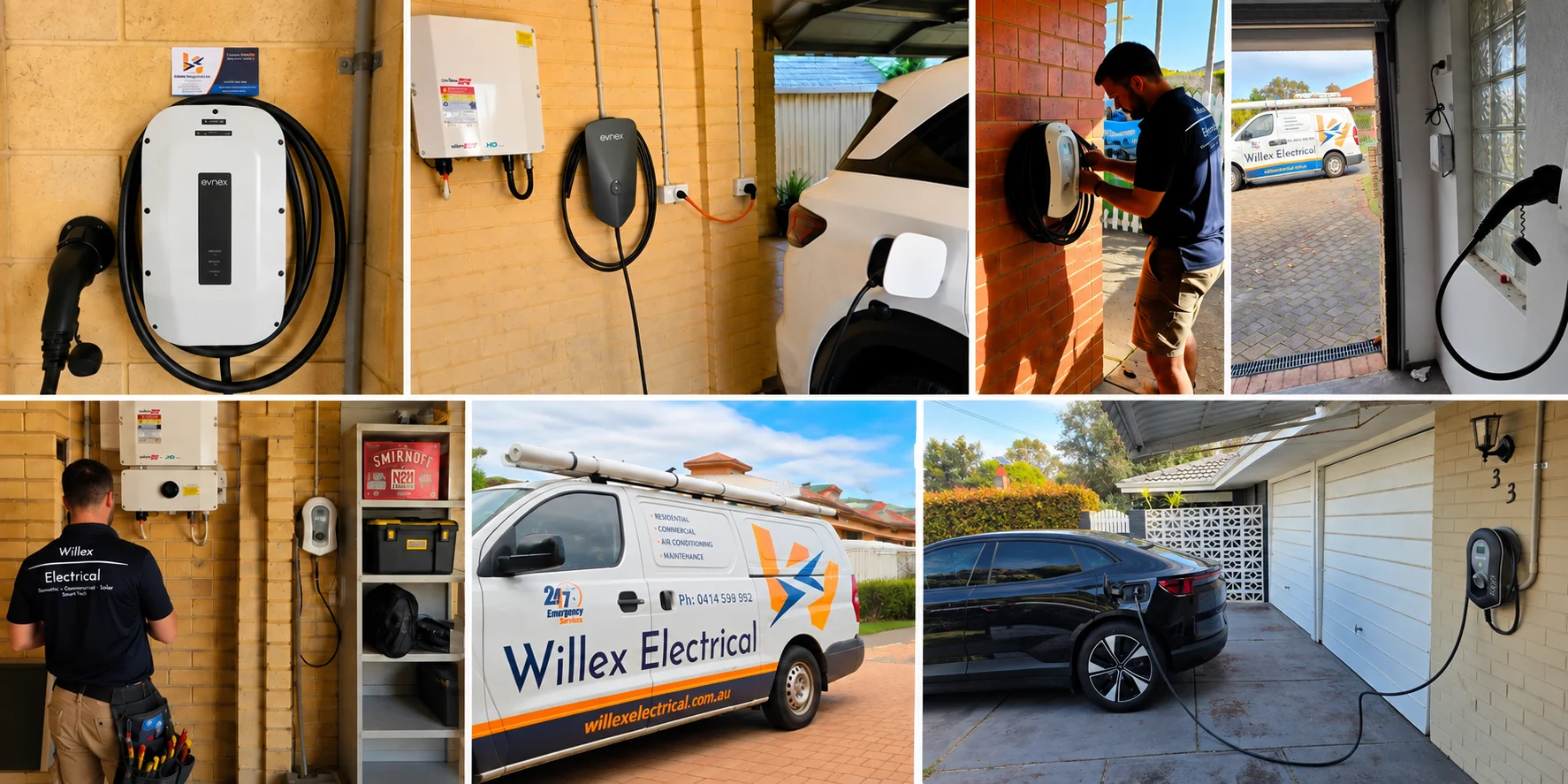
The amount of electricity required depends on the charging power of each charger.
Two chargers operating at lower current will place less demand on the home’s supply than two chargers operating continuously at 7kW.
Your household also has other electrical loads, such as:
The property’s single-phase or three-phase supply also influences how electrical loads can be distributed.
The vehicles themselves matter too. An EV with a lower maximum AC charging rate will not necessarily use the full output available from a higher-powered charger.
This is an important consideration for households with two EVs.
Imagine both cars are plugged in overnight while the air conditioning, hot-water system and other appliances are operating. If both chargers attempt to draw their maximum available power, the overall household demand can increase significantly.
This is where EV load management can help.
Rather than allowing both chargers to operate at a fixed maximum rate, a suitable system can monitor household electricity consumption and adjust the available charging power.
For example:
Lower household demand: More power can be available for EV charging.
Higher household demand: Charging power can be reduced.
Household demand falls: More charging power can become available again.
This allows charging two electric vehicles at home to work more efficiently alongside everyday electricity use.
Dynamic load management helps control EV charging based on the property’s available electrical capacity.
For a two-EV household, it can distribute available power between the charging points and other electrical loads.
This is also commonly referred to as dynamic load balancing or smart load management.
Instead of both chargers continuously demanding their maximum output, the charging system can respond to changes in household electricity consumption.
This can be particularly useful for Perth homes where upgrading the electrical supply may not be necessary or desirable simply to accommodate simultaneous EV charging.
No. Having two EVs does not automatically mean you need three-phase power.
A two EV charging setup may be possible on a single-phase property, depending on the available supply, existing household demand and proposed charger configuration.
Three-phase power can provide additional flexibility for distributing electrical loads, but it is not a universal requirement for two charging points.
A qualified electrician should assess the property before determining which arrangement is appropriate.
Not necessarily, but two dedicated charging points can be much more convenient for a two-car household.
For example, one vehicle may need a full charge overnight while the other only needs enough energy for the following day’s commute.
A smart charging system can accommodate different charging schedules and requirements.
Depending on the property, a suitable setup could include:
The right combination depends on the vehicles, daily driving requirements and electrical infrastructure.
Yes. Homes with solar PV can potentially use excess solar generation for EV charging during daylight hours.
However, solar production changes throughout the day. Cloud cover, household electricity consumption, battery charging and other factors can affect how much energy is available.
For households with solar, battery storage and two EVs, an energy-management strategy can help coordinate these different electrical loads.
Solar can therefore complement a two-EV charging system, but it should not be treated as a guaranteed source of charging power at all times.
It depends on the existing installation.
Before adding a second charging point, an electrician can assess the switchboard, electrical supply, circuit protection and available power.
The assessment may include:
Some properties may support two chargers with suitable circuit additions, while others may need electrical upgrades before installation.
There is no single solution for every Perth home.
A suitable system might involve two chargers operating at appropriate charging rates, while another property may benefit from dynamic load management to share available power.
Homes with solar, batteries, high electricity consumption or limited electrical capacity may require additional planning.
The goal is to create a charging system that provides convenient charging while working safely with the property’s existing electrical infrastructure.
If you’re planning to charge two EVs at home, Willex Electrical can assess your property’s electrical system and recommend a suitable charging configuration.
Willex Electrical is a Perth-based electrical contractor with 25 years of experience across the UK, New Zealand and Australia, including 10 years working with Western Power. The company holds WA Electrical Contractor Licence EC14820 and is a member of Master Electricians Australia and the Clean Energy Council.
Our assessment can consider your electrical supply, switchboard, existing household demand, vehicle requirements and whether load management would be suitable for your property.
Potentially. Whether both can operate at full output depends on the property’s electrical supply, existing demand and charger configuration.
No. Two EV chargers can potentially be installed on a single-phase property, subject to available electrical capacity and the proposed system design.
Not always. However, dynamic load management can help when household demand makes running both chargers at maximum output impractical.
Yes. Excess solar generation can potentially be used for EV charging, depending on solar production and the home’s electricity demand at the time.