
Choosing the right air conditioning system can make a major difference to comfort, energy use and long-term running costs in a Perth home. With hot summers and the need for reliable cooling, many homeowners compare ducted vs split system air conditioning Perth options before investing in a new system.
The right choice depends on your home’s size, layout, number of rooms, budget, insulation, lifestyle and how you want to control temperatures.
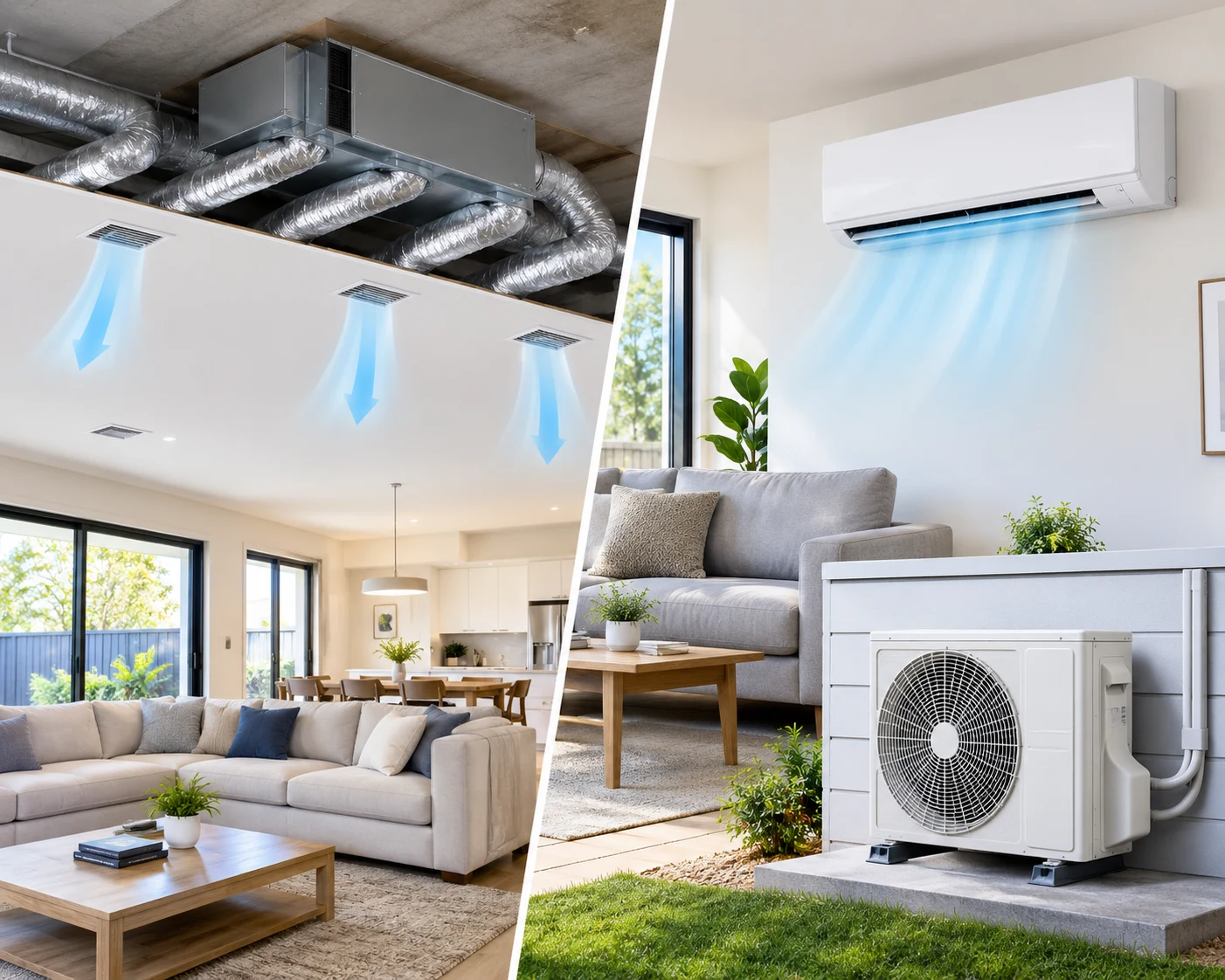
In simple terms, ducted air conditioning is designed to distribute conditioned air throughout multiple areas of a home, while a split system generally provides targeted heating or cooling for individual rooms.
A ducted system typically has a central indoor unit connected to a network of ducts and ceiling vents. It can condition multiple rooms from one integrated system, with zoning available on suitable installations.
A split system has an indoor unit connected to an outdoor unit. It is commonly installed to cool or heat a specific room or living area.
For homeowners comparing ducted vs split system air conditioning Perth, the biggest difference is how the system distributes conditioned air.
Ducted: Designed for whole-home or multi-zone comfort.
Split system: Suited to individual rooms or selected areas.
Neither option is automatically better. The most suitable system depends on the property and how each space is used.
For a larger home where you want consistent temperature control across several rooms, ducted air conditioning can be an attractive option.
For smaller homes, apartments or households that mainly use one or two living areas, split systems may provide a more practical solution.
Consider:
These factors are often more useful than simply choosing whichever system has the lowest upfront price.
A major benefit of ducted air conditioning is the ability to condition multiple rooms through one central system.
Other potential advantages include:
Zoning can be particularly useful because unused rooms do not necessarily need to be conditioned at the same level as occupied areas.
Ducted systems can involve a more complex installation than a single split system.
Potential considerations include:
The size and design of the property can significantly affect the final installation requirements.
Split systems are popular because they can provide efficient heating and cooling to individual areas without installing ductwork throughout the home.
Benefits can include:
For a homeowner who mainly uses the living room, bedroom or home office, installing a split system in specific areas may make more sense than conditioning the entire property.
Multiple split systems can become less convenient as the number of rooms increases.
You may have:
A multi-split system can provide another option where several rooms need conditioning while reducing the need for separate outdoor units.
There is no universal answer.
Running costs depend on factors such as:
A ducted system with effective zoning can allow homeowners to condition selected areas rather than the entire house.
Similarly, a split system can be economical when used selectively because you can cool or heat only the room being occupied.
The most efficient choice is therefore often the system that matches your actual usage patterns.
Both ducted and split systems can be energy efficient when correctly sized, installed and operated.
Modern systems commonly use inverter technology, which can adjust compressor output according to demand instead of operating at one fixed level.
However, equipment efficiency is only part of the picture.
Poor insulation, inappropriate system sizing, excessive temperature settings and unnecessary operation can all increase energy consumption.
For Perth homes, professional system sizing and installation are important for achieving efficient year-round performance.
Choose ducted air conditioning if:
Consider split system air conditioning if:
A professional assessment can help determine which approach suits your home’s layout and electrical requirements.
Perth homes can experience significant summer heat, making effective cooling an important consideration.
The best air conditioning system for a Perth home should be selected according to the property’s size, orientation, insulation, windows, room layout and expected usage.
Choosing an appropriately sized system is important. An oversized or undersized unit may not deliver the comfort or efficiency you expect.
Professional air conditioning installation in Perth should therefore consider the property rather than relying solely on floor area.
When comparing ducted vs split system air conditioning Perth, there is no single answer for every household.
Ducted systems are generally better suited to homeowners seeking integrated whole-home or zoned comfort. Split systems can be a practical choice for targeted room-by-room heating and cooling.
Your budget, home design, ceiling space, electricity usage and comfort requirements should all be considered before making a decision.
Willex Electrical provides air conditioning services in Perth, including air conditioner installation, servicing and repairs for residential properties.
With extensive electrical experience and a focus on safe, reliable installations, Willex Electrical can assess your home’s requirements and help determine a suitable air conditioning solution.
Willex Electrical holds Air Conditioning Licence AU 065616, supporting its capability to undertake air conditioning work in Western Australia.
The team can consider your home’s layout, electrical requirements, intended usage and preferred system type before installation.
Ducted installations can have higher upfront costs because they involve a central system and ductwork. The final price depends on the property and installation requirements.
Multiple split or multi-split systems can condition several rooms, but the appropriate configuration depends on the home’s layout and individual requirements.
It can be worthwhile for households wanting whole-home comfort, discreet vents and zoning. Whether it represents good value depends on the property and how the system will be used.
Consider your home’s size, number of rooms, ceiling space, budget, energy use and preferred level of temperature control. A professional assessment can help identify the most suitable option.